


Most outsourced business continuity programs that go wrong go wrong in the handoff, not in the work. The provider inherits a pile of stale plans, nobody says who signs off on recovery times, the contract measures hours instead of outcomes, and six months later both sides are frustrated.
This post is about the handoff. If you have already decided to bring in business continuity planning services to run your program, here is how to transfer it: what to hand over, how to split the roles, what to put in the contract, what the first 90 days should produce, and how to measure the provider once it is running.
If you are still deciding whether to outsource, and what to keep in-house, start with our guide to managed business continuity services and the math in Business Continuity Program Cost: In-House vs Outsourced. Then come back here.
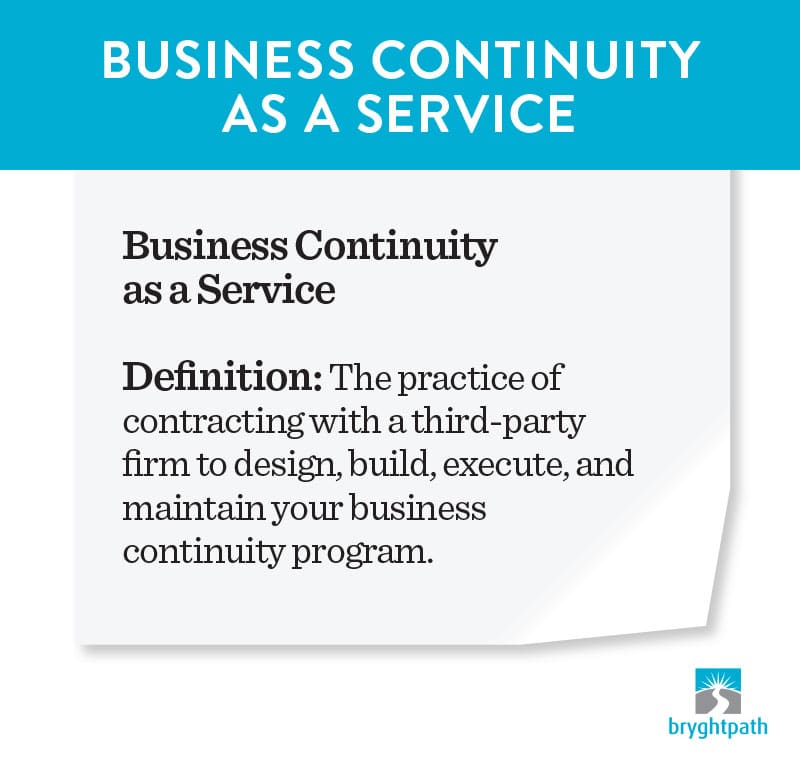
As I put it on Managing Uncertainty, Episode 109, “Business continuity as a service is the practice of contracting with a third-party firm to design, build, execute, and maintain your resiliency program.” The handoff is where you decide how much of that the provider actually gets to do.
| Old View | New View |
| Hand the provider everything you have | Hand the provider everything, then decide what to stop doing |
| The contract buys hours | The contract buys deliverables with a clear definition of done |
| The provider owns the program now | The provider runs the program; your executives own the decisions |
| Start writing plans in month one | Start with a baseline, so both sides agree where the program stands |
| Judge the provider on activity | Judge the provider on maturity, currency, and closed actions |
Three Decisions Before You Sign
1. The configuration. Business Continuity as a Service comes in a few shapes: full ownership of the lifecycle from day one, a phased start (often the Business Impact Analysis (BIA) first, then plans, then ongoing operation), or a hybrid where the provider runs day-to-day operations and your internal lead keeps strategic direction. Pick one on purpose. Most transition problems start with each side assuming a different one.
2. Business continuity alone, or the whole resilience program. If you also carry crisis management, IT disaster recovery, or an exercise program, decide now whether those move too. Handing business continuity to one firm while crisis management stays scattered recreates the problem you are paying to solve. That is what Resilience as a Service is for: one managed program across all of it.
3. Your internal point of contact. Name one person, by name, before the contract is signed. That person owns the relationship, accepts deliverables, escalates blockers, and carries the program into rooms the provider can’t enter. If nobody has the time for that, the transition will stall on the first business unit that won’t schedule its BIA.
What to Hand Over
A provider can only run what it can see. Build the handover package before kickoff, and don’t clean it up first. The mess is part of the diagnosis.
- Program documents. Policy, standards, governance charter, steering committee roster and minutes.
- Every BIA and plan, with the date each was last updated and the name of its business owner. Include the ones you know are out of date.
- Exercise history. Every After-Action Report (AAR) from the last two or three years, and the status of each open action.
- Audit and regulatory commitments. Open findings, upcoming audits, certification dates, and anything you have promised a regulator or a customer.
- IT disaster recovery material. Application tiers, recovery time and recovery point objectives, and the last DR test results. This is where the gap between what the business expects and what IT can recover usually hides.
- Critical vendor list. The third parties your critical processes depend on, and what you know about their own recovery capability.
- Tool access and data. Administrator access to your business continuity software, or the SharePoint sites, spreadsheets, and OneNote notebooks that are doing that job today.
- Incident history. What happened in the last few years, what the program did, and what didn’t work.
Then look hard at what you are capturing. When we brought on a Business Continuity as a Service client in 2022, we spent a whole month reviewing the data in its BIA and plans while moving them into a business continuity tool. Much of it wasn’t needed anymore, including detailed alternate workspace and desk requirements when only about three teams actually needed an alternate site. As I said on Episode 174, “we probably trimmed at least a third of the required time to build out BIAs and BC plans.” A transition is the cheapest moment you will ever have to simplify your business continuity program. Use it.
Split the Roles in Writing
The fastest way to lose a year is to leave the roles implied. Put a table like this in the statement of work.
| Activity | Your organization | The provider |
| Program policy and scope | Approves | Drafts and maintains |
| Steering committee | Chairs and decides | Prepares materials, facilitates, tracks actions |
| BIA | Business owners provide input; executives validate criticality and recovery times | Facilitates, analyzes, and reports |
| Business continuity plans | Business unit leaders own and approve | Writes, updates, and keeps current |
| Exercises | Participates; owns the fixes | Designs, facilitates, writes the AAR, tracks actions to closure |
| IT disaster recovery alignment | IT owns recovery capability and DR testing | Brings BIA requirements to IT and reports the gaps |
| Audit and regulatory evidence | Owns the audit relationship | Prepares the evidence and supports the audit |
| Executive and board reporting | Your sponsor presents and decides | Builds the reporting and briefs alongside your sponsor |
| A real disruption | Your crisis team and executives decide | Supports with the plan, the data, and the options |
Notice the pattern. The provider does the work. Your people own the decisions and the plans. If a plan belongs to the consultant, the business stops reading it.
What Business Continuity Planning Services Should Run
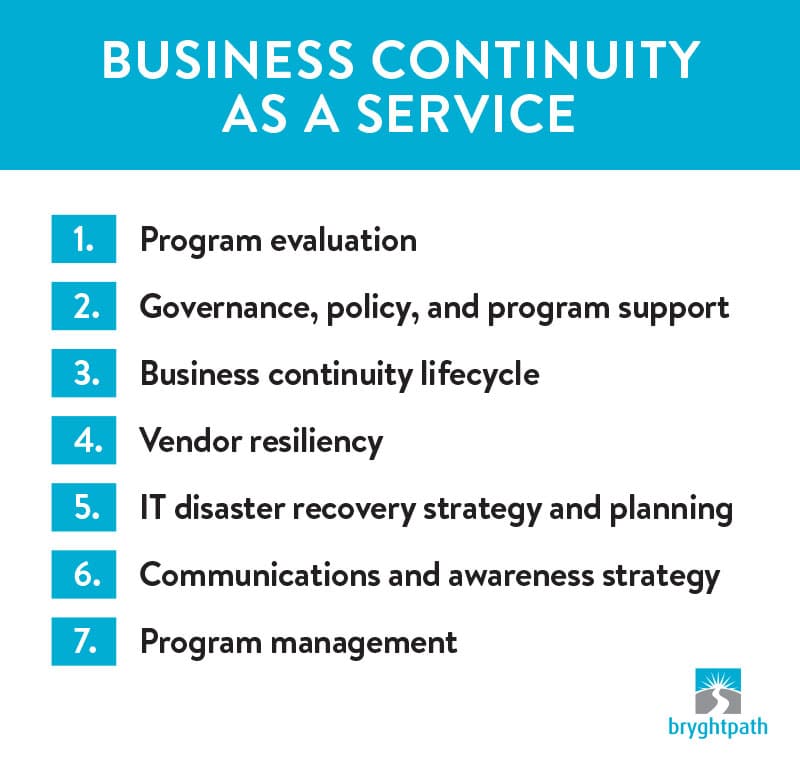
The scope you hand over should cover these seven areas, even if you phase them in: program evaluation, governance and program support, the full business continuity lifecycle (BIA, plans, training, and exercises), vendor resiliency, IT disaster recovery alignment, communications and awareness, and program management. Leave one out and you will find the gap at the worst possible time. Vendor resiliency is the one most often skipped, and your critical processes depend on third parties more every year.
Contract Terms That Matter
Most of the contract is standard. These terms are the ones that decide whether the engagement works.
- Scope in plain English. What the provider delivers, by when, and what “done” means for each deliverable. “Maintain business continuity plans” is not a scope. “Update all 40 plans in scope by September 30, each approved by its business owner” is.
- Fees tied to deliverables, not hours. We bill fixed fees tied to specific outcomes and deliverables almost all of the time. Whatever model you choose, know the cost before you start and how a change in scope gets priced.
- A named team, and named backups. Who leads your program, who covers when that person is out, and what happens if they leave the firm.
- Reporting cadence. A weekly or biweekly status review with your point of contact, and a quarterly business review with your sponsor.
- Support during a real disruption. How you reach the provider when something happens, how fast they respond, and whether that support is inside the fee.
- You own the work product. Every BIA, plan, AAR, and data set belongs to you, lives in your systems or your tool, and can be exported in a usable format.
- A transition-out clause. If you end the engagement, the provider hands the program back, or to the next firm, with the same discipline you are applying now.
For budgeting: our Business Continuity as a Service engagements start at $150,000 a year and can run into the high six figures, depending on the number of business units, sites, plans, and regulatory frameworks in play.
The First 90 Days
A good transition starts with a baseline, not with writing. Most of our engagements launch within 30 days of contract signing and begin with a Resiliency Diagnosis®, which typically runs about 12 weeks. That is your first 90 days. Here is what each month should produce.
Days 1 to 30: access and kickoff.
- Kickoff with your sponsor and point of contact; status cadence on the calendar.
- Handover package delivered; tool and document access working.
- Stakeholder list built and interviews scheduled across the business, IT, and key support functions.
- The provider introduced to the steering committee.
- Any deadline in the next six months, such as an audit or a scheduled exercise, flagged and planned.
Days 31 to 60: discovery.
- Stakeholder interviews completed. Documents show what the program says; interviews show what it does.
- Plan and BIA inventory reconciled: what exists, who owns it, and how old it is.
- Early fixes delivered where they are cheap and visible, such as missing plan owners or stale contact lists.
- Decisions made on what data to stop capturing.
Days 61 to 90: baseline and roadmap.
- A maturity score against ISO 22301 and the standards your regulators use.
- A prioritized roadmap: what to consolidate, what to cut, and what to build, in order.
- An executive briefing your sponsor can take to leadership or the board.
- The year-one program calendar approved: BIA cycle, plan updates, exercises, and reporting.
- The metrics you will judge the provider on, agreed and written down.
At day 90, both sides should be able to say the same thing about where the program stands and what happens next. If you can’t, the transition isn’t finished.
How to Measure the Provider
Measure outcomes, not activity. A provider that is busy is not the same as a program that is improving.
- Lifecycle currency. The share of BIAs and plans that are current against the calendar you approved. Our post on business continuity program metrics covers compliance, quality, and maturity measures.
- Plan quality. Not just whether a plan was updated, but whether it would work. Score it.
- Maturity, year over year. Re-measure against the day-90 baseline every year. The trend line is the scorecard.
- Exercise cadence and action closure. Did the exercises happen, and did the AAR actions get closed by their owners?
- Audit and regulatory outcomes. Findings closed, audits passed, no surprises.
- Executive engagement. Does your sponsor show up, and do your executives use the reporting to make decisions?
- Response readiness. When something real happened, did the program and the provider perform?
Review all of it at the quarterly business review. If the numbers aren’t moving after two quarters, say so and change something.
What It Looks Like in Practice
For a major healthcare technology company with HITRUST, HIPAA, and PCI DSS obligations, we started with a Resiliency Diagnosis® and interviewed dozens of key staff before we ran anything. For several years since, we have run its business continuity, crisis management, and disaster recovery programs day to day: quarterly crisis management and business continuity exercises, an ongoing awareness campaign, immediate help during disruptions, and an annual Resiliency Diagnosis® maturity evaluation. The result the client sees is consistent maturity growth, measured the same way every year.
That is the shape of a good transition: a shared baseline, a written split of roles, and a yearly measurement that tells both sides whether it is working.
The handoff is the first test of your provider. Make it a hard one.
Keep Going
A few ways to go deeper if this was useful.
- Read more. Resilience, crisis management, and continuity writing at Bryghtpath Insights, or the getting help section of our Ultimate Guide to Business Continuity.
- See how BCaaS works. Business Continuity as a Service puts your program in the hands of senior practitioners who run it day to day.
- Get a maturity score. Our Resiliency Diagnosis® is a standards-based review that produces a maturity score and a prioritized roadmap.
- Talk to us. Set up a call to think through how to hand over your program.